
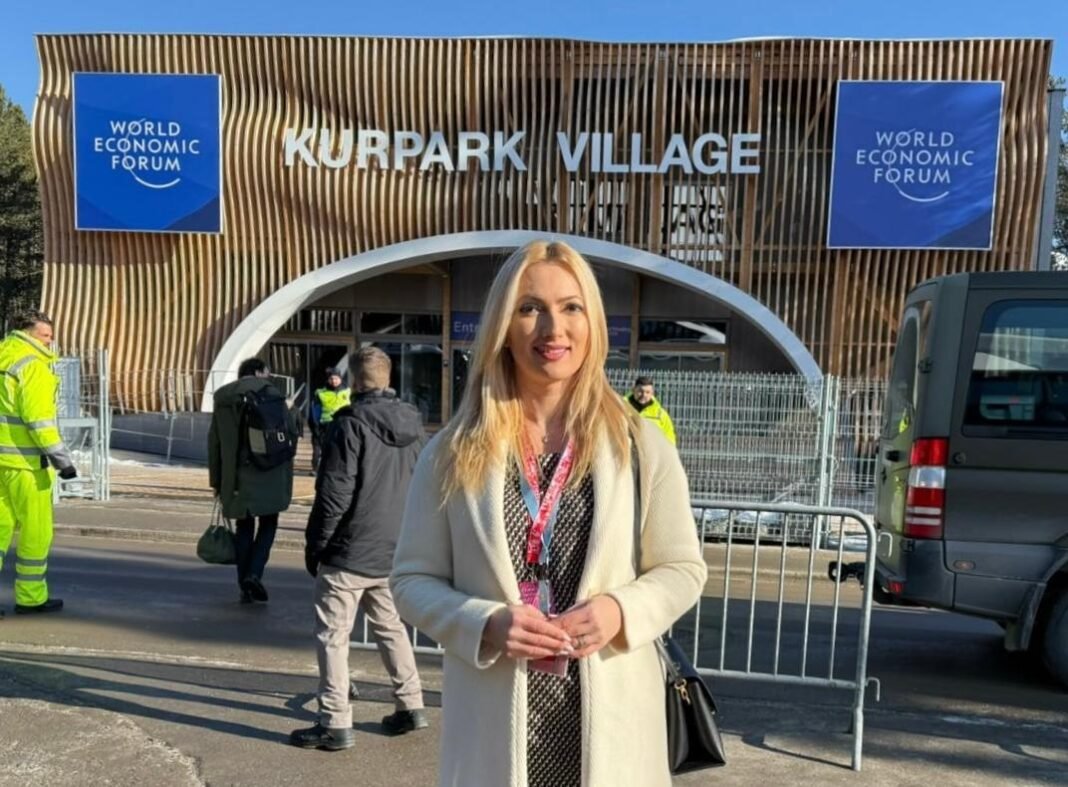

Exclusive interview with businesswoman Malina Turcut, Chief Financial Officer of Prime Dashqe, whom we met at Davos – WEF and which operates in several countries around the world
The name of Malina Turcut, whom we met at Davos – WEF, is not unknown in the business world, especially in the countries where she operates, such as the United Arab Emirates, the USA and Romania. In an exclusive interview for the Swiss newspaper LeCanton27.ch, she talks about her visit to Davos, the WEF proceedings, but also about her mission and activities in several countries around the world, including those in the Balkans….
- At the World Economic Forum in Davos, among many international figures, we met Malina Turcut, a businesswoman with operations in Dubai, the United States, Great Britain, and Romania. Ms. Turcut, could you first tell us why you are in Davos?
 Malina Turcut: I’ve been participating in many international events over the years, across different regions and industries. This year, being invited by the Forbes Middle East team to join them here in Davos was a very natural decision for me — so I accepted the invitation, and here I am. We’re clearly living through a period of major change. Globally, politically and economically, things are shifting very fast — and what many describe as a new world order is having a direct impact on how businesses operate, invest, and grow today.
That’s why being here matters. Davos is one of the few places where decisions are discussed at their source, where leaders from politics, finance, and industry come together. For anyone building global businesses or financial infrastructure, it’s important to be present where these conversations happen and to understand how the world is being reshaped.
- Could you tell us more about your work and your activities? What do you offer your clients, or what do they ask of you?
 Malina Turcut: One of the biggest challenges we see today is that the global supply chain and SME financing gap is enormous — and it’s a hidden drag on global growth. According to the latest estimates from the IFC–World Bank MSME Finance Gap Report, across 119 emerging and developing markets there is a $5.7 trillion financing gap for micro, small, and medium enterprises — that’s roughly 19 % of GDP and 20 % of total private sector credit that SMEs can’t access through traditional financial systems. This unmet demand isn’t theoretical — it results in slower growth, delayed supplier payments, constrained production cycles, and missed GDP expansion across markets.
That gap is precisely the problem Prime Dash is solving
We embed finance directly where trade happens — into the actual supply chains of global brands, distributors, and SMEs. By using real transactional and behavioural data, we can provide instant working capital based on commercial activity, shifting financing from a post-trade chase to a pre-emptive enabler of growth.
This means:
• SMEs get capital before funds are stuck in receivables,
• Buyers can extend payment terms without hurting suppliers,
• And the entire ecosystem becomes more liquid, resilient, and growth-oriented.
By turning the estimated trillions of dollars of unmet finance into accessible capital, we unlock real economic value — not just for individual businesses but for entire value chains.
- Given that your business extends to America, Great Britain, Dubai, and other countries, are you considering partnering with Switzerland or certain Balkan countries, such as Albania, Serbia, or Kosovo?
Malina Turcut: We are very open toanykind of collaborationsandproposals. What we do is work with global ecosystems and global teams. In our case, we work very closely with Mastercard teams that cover different regions and geographies, and with partners that operate across multiple markets at the same time. So our focus is less on borders and more on where trade and supply chains are actually happening. Wherever our partners need us — whether that’s Europe, the Middle East, the Americas, or emerging markets — we go with them and support them in the markets they operate in. That flexibility is essential today, because supply chains are global, and the financial infrastructure that supports them has to move just as seamlessly.